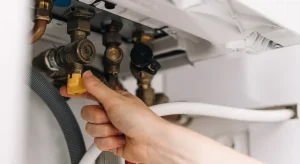
Why Is My Boiler Losing Pressure? Causes, Fixes and When to Call an Engineer
Boiler Repair
Low boiler pressure is usually caused by a small leak or trapped air. Top it up safely using the filling loop, and call an engineer if it drops again.

If you’re due a new boiler in the next few years, you’ve probably noticed the conversation around home heating has shifted from straightforward replacement to hydrogen readiness, hybrid systems, heat pumps and now discussions about when gas boilers might disappear altogether. It’s easy to feel like you need an engineering degree just to understand your options.
With over 30 years of experience fitting and servicing boilers across Dorset, our team at Greenstar is on hand to cut through that noise and explain the future of home heating in terms that actually make sense before you have to make a decision. So, with that in mind, let’s start with what’s actually changing, and when.
The gas boiler phase-out timeline is worth understanding, but it’s rarely explained in a way that removes the worry. Government policy aims for low-carbon heating to make up most boiler replacements by 2035, and new-build homes will be required to use low-carbon systems such as heat pumps from the late 2020s.
However, there is currently no legislated ban or fixed cut-off date for installing new gas boilers in most existing homes. Importantly, this isn’t a ban on the boiler already sitting in your airing cupboard. If your current system is working safely and efficiently, there’s no requirement to replace it overnight. What it does mean is that, over time, the market around heating will shift towards low-carbon options, so it’s worth understanding your choices early rather than waiting for a breakdown to force the decision [1].
The Boiler Upgrade Scheme (BUS) is one part of that changing picture, designed to make the switch away from a traditional gas boiler less of a financial gamble. In simple terms, it’s a government grant that puts money towards installing a heat pump or, in some cases, a biomass boiler, reducing the upfront cost that has always put people off making the change [2].
You don’t need a failing boiler to apply, and the scheme sits alongside your own choice of installer. For a lot of homeowners, this is the first real financial nudge towards the future of home heating, rather than a rule being forced on them. It won’t suit every property, particularly older homes with poor insulation, so it’s worth asking your engineer.
If a heat pump isn’t the right fit for your home, hydrogen-ready boilers are one of the innovative home heating systems being developed as a more familiar alternative. These boilers run on natural gas as normal today, but with the internal components in place to switch over to hydrogen, or a hydrogen blend, if and when that fuel becomes available in your area.
The appeal is that these boilers look and behave much like the one you already have, so there’s no need to rip out radiators or rethink how your home is heated. The catch is that widespread hydrogen supply to homes is still years away. For most homeowners today, a hydrogen-ready boiler is a sensible, low-risk choice if you’re due a replacement now [3] [4] [5] [6].
Hybrid heating systems sit in a similar middle ground, combining a smaller heat pump with a traditional boiler so the two work together depending on the weather. On milder days, the heat pump does most of the work, and the boiler steps in during colder spells when extra output is needed, giving you a taste of low carbon heating systems without a complete overhaul of your home.
For homes that rely on oil rather than mains gas, HVO-ready boilers offer a comparable route forward. HVO, or hydrotreated vegetable oil, is a renewable alternative to standard heating oil, letting rural and off-grid properties lower their carbon footprint without switching to a different type of system. Both share the same idea, which is that you don’t have to choose between old and new at once.
Not every improvement to how your home is heated requires replacing the boiler itself. Smart boiler technology, such as connected thermostats and weather-compensating controls, lets your existing system run more efficiently by adjusting output to the actual temperature outside rather than a fixed setting.
It’s one of the simplest and most affordable innovative home heating systems to adopt, often paying for itself through lower energy bills within a year or two. These controls also give you a clearer picture of how your heating behaves day to day, making it easier to spot problems early. For many households, upgrading the controls rather than the boiler is a practical first step towards the future of home heating, without needing any of the bigger decisions covered above.
With so many options now available, it helps to think about your own home rather than the technology. If your property is well insulated and you’re open to a bigger change, the Boiler Upgrade Scheme can make a heat pump genuinely affordable. If you’d rather ease into things, hybrid heating systems or hydrogen-ready boilers let you keep much of what you already have while staying ready for what comes next.
Off-grid or rural properties often find HVO-ready boilers the most practical route, particularly where a full electrical upgrade isn’t realistic. None of these choices need to be made in a panic, and the right answer depends on your property’s age and how soon your boiler needs replacing. An engineer can help you plan for the future of home heating.
Whatever stage you’re at, whether your boiler is working fine for now or you’re already weighing up the options above, our engineers are happy to talk you through what suits your home rather than pushing you towards the newest technology by default.
Call us on 01202 355 344 or fill in our online contact form, and we’ll give you honest, practical advice on the future of home heating, built around your property rather than a sales target.
[1] Carbon Brief, ‘Q&A: The UK Government’s ‘Carbon Budget Delivery Plan’ for 2035’: https://www.carbonbrief.org/qa-the-uk-governments-carbon-budget-delivery-plan-for-2035
[2] GOV.UK, ‘Apply for the Boiler Upgrade Scheme’: https://www.gov.uk/apply-boiler-upgrade-scheme
[3] GOV.UK, ‘Heat and Buildings Strategy’: https://www.gov.uk/government/publications/heat-and-buildings-strategy/heat-and-building-strategy-accessible-webpage
[4] British Gas, ‘Hydrogen Boilers: Everything You Need to Know’: https://www.britishgas.co.uk/heating/guides/hydrogen-heating.html
[5] Ofgem, ‘Network Innovation Competition: H100 Fife’: https://www.ofgem.gov.uk/sites/default/files/docs/2020/11/nic_2020_h100_fife_final_submission_20.10.20_-_redacted_ofgem_publication_applied.pdf
[6] UK Parliament, ‘Retrofitting Homes for Net Zero’: https://publications.parliament.uk/pa/cm5901/cmselect/cmesnz/453/report.html

Recent Posts
Low boiler pressure is usually caused by a small leak or trapped air. Top it up safely using the filling loop, and call an engineer if it drops again.

Knowing how to check if a boiler is gas safe starts with the engineer. Check their ID card, match the number on the Gas Safe Register and see the papers.

UK boiler installation regulations require Gas Safe registration, council notification and a compliance certificate for every new or replacement boiler.